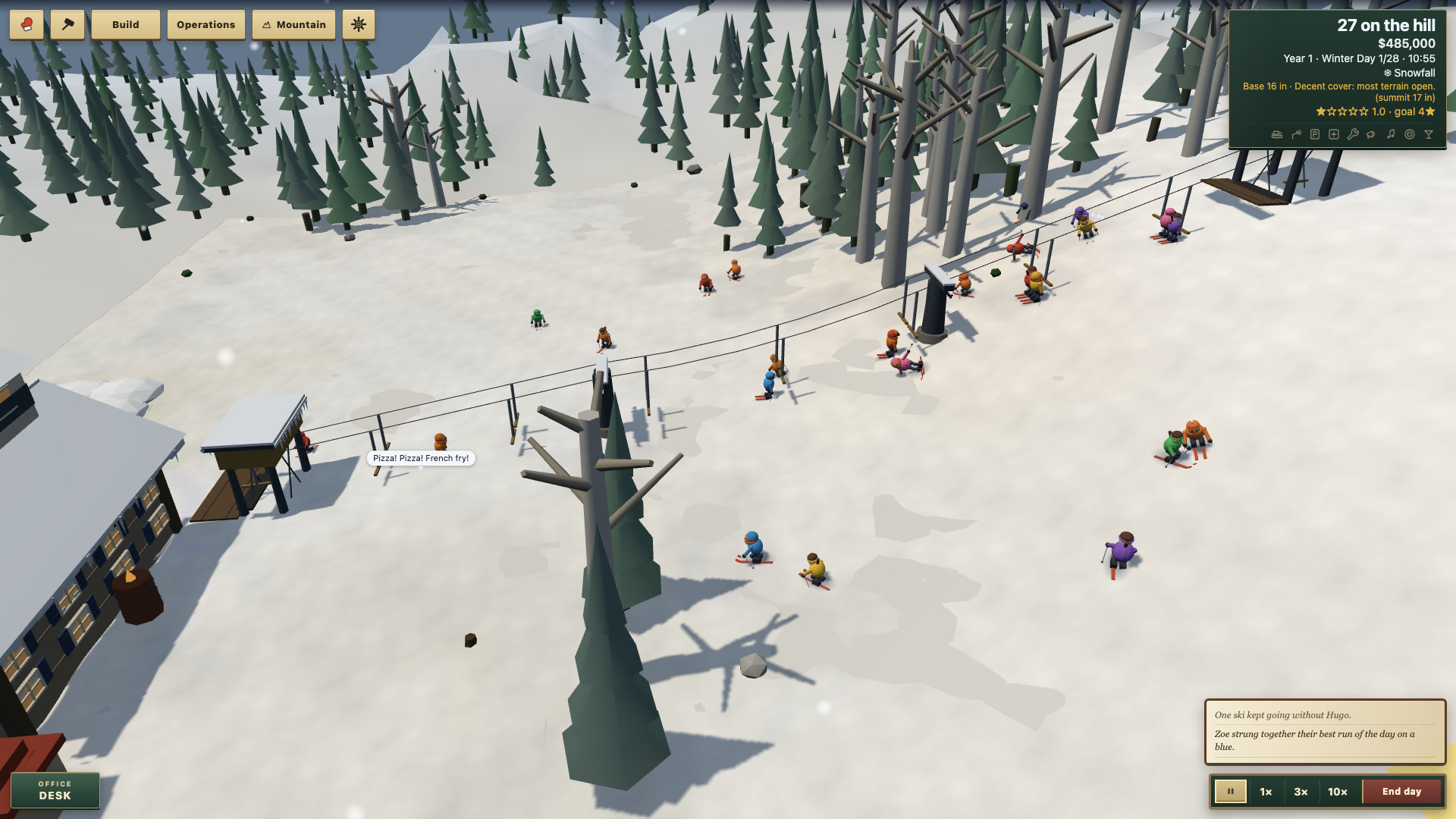
A lift converts base access into mountain access. Its useful capacity depends on more than the machinery: guests must reach the loading area, unload safely, find suitable terrain, and return without dead ends.
Page 12
A lift is a promise of flow
A functioning pod connects arrival, lift access, and a skiable return.
A lift converts base access into mountain access. Its useful capacity depends on more than the machinery: guests must reach the loading area, unload safely, find suitable terrain, and return without dead ends.
Place for a network, not a postcard. A lower-cost lift serving a coherent pod can outperform a larger machine connected to weak terrain.
Page 13
Cleared is not the same as connected
Terrain becomes useful when it forms a continuous, reachable route. Inspect every junction, crossing, and return. A beautiful strip of cleared snow that fails to connect remains scenery.
Route difficulty should fit the guests you are attracting. Growth can stall if new arrivals cannot find terrain they are willing or able to ski.
Trace the route from unload to base
Check junctions and one-way traps
Match terrain difficulty to guest mix
Provide alternatives before demand overwhelms one line
Page 14
Find the useful bottleneck
Advertised lift capacity does not guarantee mountain throughput. The drop-off lane, ticketing, route distribution, loading access, and guest services can limit the number of satisfying ski days before the bullwheel does.
When a queue grows, follow the guest journey backward and forward. Solve the narrowest useful point instead of automatically buying a bigger lift.
Page 15
Build redundancy with purpose
A second route can spread skiers, serve another skill group, and keep part of the hill useful when conditions or maintenance close an option. Redundancy is insurance only if both paths are reachable and operational.
Expand after measuring where guests actually go. The right next pod may serve unmet demand rather than the highest summit.